In Ellen Charry’s book By the Renewing of Your Minds she reclaims the pastoral role of Christian doctrines, once part of the theologian’s basic instruction, in the formation and development of our Christian life. The process of a cultivation of Christian virtues needs to be strengthened with theological content and not only with habits or repetitive actions. This is a very insightful claim that shapes the whole book through its chapters. If used rightly, Christian doctrine is an excellent means to nurture and discern one’s personal life and our communal life. Christian theology — patristic, medieval, or modern — serves …
Kant believes natural law is written in the human heart. For him, the highest good can be understood as happiness, which is distributed in exact proportion to morality (First Critique). Therefore, in a sense, the highest good can be defined as the combination of happiness and virtue. However, this definition is not clearly held in all Kantian writings, something which arises an ambiguity that has been the object of ongoing research. For instance, in the Second Critique, Kant also speaks of the supreme good as a consummated or transcended good. A widespread way to approach the issue has been claiming …
Calvin’s understanding of natural law (also known as the interior law) can be clearly appreciated in a series of passages of his Institutes, but especially in his Commentary to Romans 2:14-16. Verse 14 of this passage states that the Gentiles by nature do what is established in the law, and this makes their natural disposition serve as a law for them. Calvin uses this verse to offer his own definition of natural law, where he connects natural law with people’s natural disposition. Calvin argues the Gentiles must have some rule of righteousness, for there is no nation so lost to …
For Aquinas, everything is regulated by eternal law or God’s creation order (I-II, Q.91, a.3), so it is no surprise that he understands natural law as participation of the eternal law, where natural law is of a general and teleological character (See I-II, Q.91, a.2). In Aquinas’s vision, natural law is linked with divine reason rather than with the will of God, as theologians such as Calvin would suggest. This opens the door for considering Aquinas’s notion of natural law to be expansive in the sense that natural law is associated with human’s capacity to reason and producing reflection. When …
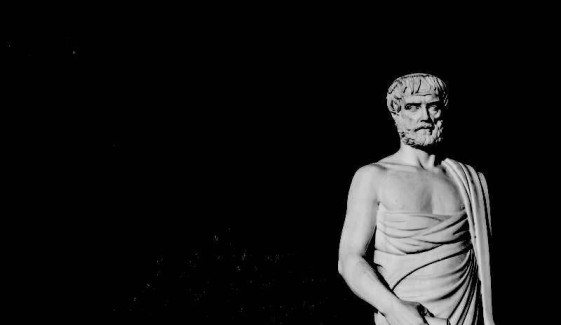
Aristotle’s starting point of his discussion of happiness can be found in Book One, Chapters 1-10 of Nicomachean Ethics, where he discusses the relation between the good of an action/decision, for instance, and its goal or purpose. Aristotle argues that all human activity aims or attains at least some good associated with it. It is not so difficult, therefore, to connect happiness with what most people consider to be good. This point is central because it constitutes one of the supporting arguments for Aristotle’s discussion that the goal or purpose of human life is reaching happiness. Although people can observe …
First, it is important to note that Prof. Hauerwas is doing sexual ethics outside of the mainstream Christian theologians such as Augustine and Aquinas. Therefore, his position and discussion must be understood as a reaction against the Western moral tradition. Bearing in mind these clarifications could help us to avoid misunderstanding him. Hauerwas is very critical of the Christian large tradition on this topic. He believes the tradition has failed when discussing human sexuality/sexual ethics in a very broad sense by clinging exclusively to natural law. This is something that the church must correct if she wants to avoid confusion …
For Christian ethicist Oliver O’Donovan, God’s revelation in the gospel is the basis and primary authority of Christian ethics. So it is also the means Christians can discern the truths about the natural world through the work done in the resurrection of Christ. In other words, the renewed order, revealed through the resurrection of Christ, allows us to be aware and understand fully the created order. Here we note that O’Donovan defends an objective and realized-eschatological approach to Christian ethics, including his approach to human sexuality. This allows him to claim a clear distinctive differentiation between the creator and the …
Although Aquinas has certain similarities with Augustine regarding sexuality, he departs from him in some other particular respects. Aquinas’s discussions in Summa Theologia about sexuality are brief; one clearly sees, however, how Aquinas interpreted human sexuality through the lens of natural law and rational abstraction. Through his holistic view of the human being as a composite of soul and body, Aquinas does not leave room for a separation between gender and sex. The soul informs the human body of this essential information. For instance, the gender or sex is randomly assigned by the soul. In addition, without a doubt, Aquinas …
As part of the mainstream Christian tradition, Augustine has significantly shaped the conversation about how Christianity has understood and approached sexuality throughout the years since the early Church, including the fact that human beings were created both male and female. However, something we must consider when one tries to find out Augustine’s views on human sexuality is that his understanding of marriage and social norms strongly influenced his views. To make things even more difficult, Elizabeth A. Clark (Professor of Religion, Duke University) asserts that Augustine links women with the physical world and such a link affected Augustine’s conclusions on …
The purpose of this study is exploring John Calvin’s two-fold notion of faith in the 1559 Institutes and its central implications for pastoral theology in the emerging Reformed tradition in order to reclaim a broader and contextualized understanding of pastoral care and its relation with faith formation. To that end, this paper will focus on the ways the emerging Reformed church of second mid-sixteenth century in Geneva applied the Calvinian notion of faith to pastoral theology. It also explores some applications of such an understanding, especially for the modern American-Dutch reformed church. In the Reformed faith Calvin’s two-fold notion of …
John Calvin was a sixteenth-century French theologian. On the advice of his father, he studied law at university. This was an opportunity to get acquainted with humanism, classical languages, and philosophy. In 1533, he came into contact with some folks who were against the Catholic doctrines, and this opened the door for Calvin to question his Catholic faith and experience a conversion. However, it was not until 1536 that he arrived in Geneva and left Catholicism in its totality. By the same year, he had prepared what became the first edition of the Institutes, a manual of basic teachings of …
Traditionally, the formal origin of covenant theology goes back to Cocceius. However, elements of the covenant theology can be found throughout the whole Scriptures in a broad sense. The notion and language of covenant, grace, works, and promise were well known by the early Church and Catholic theologians before the Reformation. Passages such as Gen. 3:15, Rom. 11, Deut. 29;1, and Hos. 6:7, show such language, for example. Nonetheless, properly speaking, the theology of covenant as we know it today has its origin in the larger development of the sixteenth-century Reformation. Zwingli, a contemporary of Luther, is known for defending …