Heinrich Bullinger Portrait

Ranging three centuries, McCoy and Bakers attempt to trace the development of federalism from 16th-century Reformers until the start of political federalism with the promulgation of the United States Constitution. They try to retrieve the role that federalism has had in modern society (political/philosophical federalism) and in theology (covenant theology), pointing it out Heinrich Bullinger as the first one to start this tradition. In general, federalism highlights the importance of covenants in the relation between God and humankind, even it can be applied to the relation between humans or social groups, for instance. In this regard, if McCoy and Baker …

Counter-Reformation

Certain debate has stirred up around the name of the different Catholic movements that had the aim of defending or reforming the Catholic church. Can we call it a Counter-Reformation? What about a Catholic Reformation? Or, is there a better label to name these important movements? Many scholars who have studied the issue have questioned the same thing. Italian historian Massimo Firpo, among them. Catholic historian H. Jedin, on the basis that the term Counter-Reformation to define the period between the 16th century and 17th century where the Catholic church responded/reacted to the Protestant Reformation, argues for a redefinition of …

Council of Trent

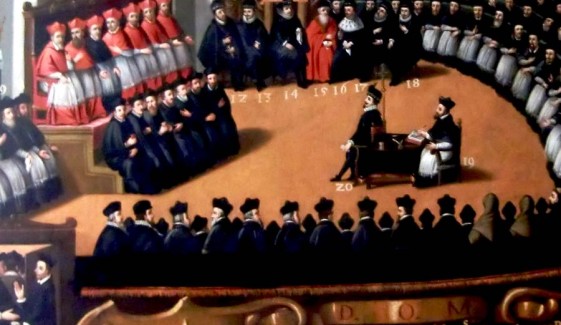
What roles did Pope Paul III, Ignatius Loyola and the Jesuits, and the Council of Trent play in the Counter-Reformation? In the following post, I will briefly answer these questions and provide a brief overview of the Catholic/Counter-Reformation, including its roots. First of all, the Catholic/Counter-Reformation Reformation was the response and/or reaction of the Catholic church toward the challenges made by the sixteenth-century Protestant Reformation. The Protestant Reformation started with Luther’s proclamation of the 95 theses in 1517 while Leo X was the Pope of the Catholic church. But it was not until the papacy of Paul III that significant …

Herman Bavinck Portrait

In dealing with arguments against the Christian faith in his book The Philosophy of Religion, Bavinck uses a series of argumentative strategies. One of these strategies is the apologetics of despair. This study tries to figure out whether this strategy tends to be observed in most essays of the book or its use is only circumstantial. Bavinck does not reject at once and for all the ideas that may be detrimental to the faith, but instead, he engages with them in order to discover if they can offer some truth worth noting. In this respect, in the three essays discussed …

Stewardship

Dave Davis explores whether pastors must be involved more in the financial process in their congregations. For Davis, such involvement includes knowing what amount of money each member gives, or at least, the persons who give the most. This raises the question of whether giving should be personal but not private. In this brief reflection, I respond with a “yes” to this question regardless of socio-cultural context. I offer brief reasons. In a church context where people give money for the administration of the congregation, I think how the money is earned, spent, saved, and alike, all of these aspects …

Stewardship

It is an open secret that money is a taboo in the church, especially in our North American context. This reminds me of two key principles from Walter Brueggemann’s Money and Possessions because of their impact to my pastoral leadership: God constitutes the source of gifts and all goodness (First Principle) and human beings have been trusted to be faithful stewards of God’s gifts (Third Principle). These two principles are important not only for our Christian life but also for our development as leaders in the church. One thing is claiming that God is the source of everything, and another …

Walter Brueggemann

In his Money and Possessions, Walter Brueggemann deduces from the Scriptures six general principles that can help to better understand how the Hebrew and Christian Bible inform us about money and possessions. Although there can be more than these six principles, Brueggemann asserts that these six are the clearest to him. In a nutshell, the first principle has to do with God being the source of gifts and all goodness. Brueggemann finds support for this principle in the Genesis narrative of the creation. God is not only the creator of all living creatures but also the provider, where he has …

Henri Nouwen

What is the central aspect of fundraising? This is the question I will address in this blog post using as a resource Dutch theologian Henri Nouwen’s discussion of the topic. Two features I find compelling in Nouwen’s A Spirituality of Fundraising are the role of contemplation (e.g. prayer and gratitude) and spiritual communion in a person’s development of a biblical-based perspective on money. For Nouwen, there is a close relationship between money fundraising and spiritual communion. He argues that such a spiritual communion comes from God’s desire to have communion with human beings. Such a desire is also reflected among …

Stewardship series – Sharing coffee with a church treasurer

Discussing the budgeting process with the Church treasurer (CT) of a friend’s congregation, I realized this church uses a formal process with a team receiving all the financial information, who process all data provided by the staff and reporting back quarterly. It surprised me to discover that there are two financial officers in the congregation who work with the financial team to oversight all finances and better control them after a series of difficult challenges in the past. Each ministry has a designated budget managed by the director of that ministry. If extra money is needed after the budget is …

Stewardship

If there is a phrase that characterizes my closer family, parents and siblings, is: “Money must not be squandered.” My parents used to remind this to me while growing up. I can say that my family cannot be considered spenders at all. It did not matter how well or not our finances were, my parents always encouraged me to put some money into the bank. Not surprisingly, they did not hesitate to open saving accounts for me and my siblings. In this respect, the message I received from them was that money can help someone or cause damage. Such an …

Stewardship

Reflecting on what Jeff Manion wrote on pages 104-06 in his book Satisfied about writing a journal for life, it gets my attention what he says: I write.. because I am prone to forget that I am deeply loved by the Father. I reminded myself that I am his. He adopted me, paid for me, and I am his. I am his cherished son. His treasured kid (see p. 105). In the same way we write our prayers and notes in a journal, calculating a budget in a sheet resembles journal writing. In fact, I would define a budget as …

Jacques Ellul

Is it possible for Christians to experience a sense of vocation in the contemporary world of work? This is the question French philosopher and Reformed theologian Jacques Ellul tries to answer. Departing from what can be considered a majority consensus in the Reformed tradition, Ellul rejects, in his view of vocation, the idea that in the Scriptures we can understand the terms vocation and work as having the same meaning. Rather, he argues that both terms must be understood differently, and for this reason, Christians cannot experience their sense of vocation in the same way people in mainstream society understand …