What roles did Pope Paul III, Ignatius Loyola and the Jesuits, and the Council of Trent play in the Counter-Reformation? In the following post, I will briefly answer these questions and provide a brief overview of the Catholic/Counter-Reformation, including its roots.
First of all, the Catholic/Counter-Reformation Reformation was the response and/or reaction of the Catholic church toward the challenges made by the sixteenth-century Protestant Reformation. The Protestant Reformation started with Luther’s proclamation of the 95 theses in 1517 while Leo X was the Pope of the Catholic church. But it was not until the papacy of Paul III that significant changes and responses arose from the Catholic church.
Paul III, in some respects, was in agreement with some of the problems revealed by Luther and others. For instance, Paul III agreed, to a certain point, that the church clergy and the process of selecting candidates for ministry needed to improve. An important step Paul III took was to promote the creation of new orders within the church. Because of it, the Order of the Jesuits was born. Despite the measures taken by Paul III, it was Pope Paul IV who took a more aggressive strategy against the Protestant Reformation. During the papacy of Paul IV, it was created the Index of Forbidden Books, which had the purpose of creating a list of apparent heretic European books with the objective of destroying them for the promotion of the Protestant Reformation and/for damaging the image of the Catholic church, including the attack of her doctrines. Not surprisingly, Paul IV was most known for being responsible for re-establishing the Holy Inquisition to control heretics in Rome.
Regarding the importance of Ignatio Loyola in the Catholic/Counter-Reformation, it is important to mention that he was the priest who founded the Order of the Jesuits or Society of Jesus after Pope Paul III approved the project submitted to him. The Order emphasized religious education, besides promoting total obedience, submission, and service to the Pope. The emphasis on chastity and poverty was also made. In some senses, the new Order resembled the Protestant emphasis on theological education. The Jesuits’ process of formation focused on the study of the humanities, theology, and philosophy. Perhaps this has been the reason many teachers in Catholic colleges and schools belong to this Order. Finally, since its creation, the Jesuits have been in hot debates with Protestants in Europe, Asia, and Latin America. Loyola is also known for promoting aesthetic spiritual exercises, which were a list of contemplative practices such as prayers, reflection, meditation, etc. to promote spiritual growth in believers. More recently, well-known Catholic theologians who belonged to this Order included Chardin, Balthasar and Rahner. As noted, the Jesuits played a fundamental role in what we might call the “Catholic Reformation,” bringing a renewal to the clergy.
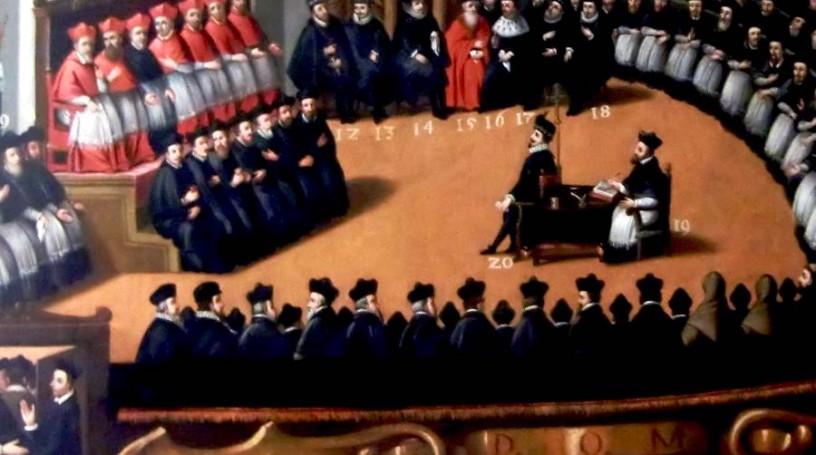
The Council of Trent was the other major response to the Protestant Reformation that arose from the Catholic/Counter-Reformation movement. The ecumenical Council was developed over 18 years around the mid-sixteenth century in Europe. The purpose of the Council was to discuss and explain the Catholic doctrines that had been attacked during the Reformation. The discussion of the Council were developed taking four major areas as starting points: the response to the Protestant emphasis on Sola Scriptura, the definition of heresies regarding the Sacraments, establishing clear differences between the Catholic doctrine and Lutheranism, the emphasis on clergy improvement based on moral grounds, and the solidification of Papal authority. It is in this respect where resides the importance of the Council — it was the opportunity of the Catholic church to clarify important elements of several doctrines such considering Scripture and tradition was reliable sources of revelation, affirming the doctrine of justification by grace, the defense of the prohibition of marriage among priests, the adoption of an official text of the Scriptures such as the Vulgata Latina, the affirmation of the real presence of Christ in the mass, and the defense of the Papal authority, among others. The Council also polished the Catholic liturgy and its systematization of the Roman rite, establishing a new standard for the Roman Catholic Mass.
In conclusion, the creation of the Order of the Jesuits, the establishment of the Holy Inquisition, and, the Council of Trent can be considered, generally, the major ways in which the Catholic church responded (in one sense) and reacted (in the other sense) to/against the Protestant Reformation started by Luther and early Reformers. Perhaps the biggest benefit for Catholicism in all this process was the revision and consolidation of the Catholic doctrines that resulted from the decisions adopted by the ecumenical Council. Although there were two major clerical positions represented on the Council, those who supported a strong reaction to Protestantism and those who believed the answer should be a more ecumenical approach, the strong response prevailed. This fact definitely shaped the way in which the Catholic church responded to the challenges. As appreciated earlier, the response was energetic and very oppressive in many respects to the Protestant faith. This was something that was observed much later in the places where the Inquisition was established, such as Spain, Mexico, France, and other important countries where Catholicism was the majority.